


Does Organic Hair Growth Shampoo Actually Work?
Table of Contents
- What Organic Hair Growth Shampoo Can Actually Do
- How Hair Growth Shampoos Work at the Scalp Level
- Best Ingredients for Hair Growth in Organic Formulas
- How Long Does Hair Growth Shampoo Take to Work
- Understanding the Shedding Phase and Purging
- Organic Versus Synthetic: What the Evidence Shows
- What Shampoo Cannot Do Alone
- Conclusion
Last Updated: August 14, 2026
What Organic Hair Growth Shampoo Can Actually Do
The promise is simple: wash your hair, watch it grow thicker and fuller. The reality is more nuanced. A quality organic hair growth shampoo can support scalp health, reduce breakage, and create conditions where hair thrives through plant-based actives that nourish follicles and strengthen the hair shaft. What it cannot do is reverse genetic hair loss or work like a pharmaceutical treatment. The shampoo sits on your scalp for 2-3 minutes during each wash, a brief window to deliver ingredients that support follicle function and scalp circulation, but not enough to override your DNA or hormonal factors driving pattern hair loss.
The most honest assessment: organic hair growth shampoo is a foundation tool, not a standalone solution. It works best as part of a consistent routine, paired with other supportive practices. If your hair thinning is driven by poor scalp health, breakage, or suboptimal hair care habits, a targeted organic formula can make a measurable difference. If your hair loss is driven by genetics or medical conditions, the shampoo is a helpful complement to other treatments, not a replacement.
At Harmony Harvest, we formulate our Hair Care range with this realistic framework in mind. Our COSMOS-certified organic shampoos are designed to support scalp health and hair strength through plant-based botanicals, not to make false claims about what topical products can achieve.
How Hair Growth Shampoos Work at the Scalp Level
Hair growth shampoos work by delivering active ingredients directly to the scalp and hair follicle environment. The scalp is where follicle stimulation begins, and its health directly influences the hair that emerges from it.
When you apply a targeted shampoo, the actives penetrate the scalp's outer layers and interact with the follicle and surrounding tissue. Plant-based ingredients like caffeine can increase scalp circulation, bringing more nutrients and oxygen to the dermal papilla, the nutrient centre at the base of each follicle. Rosemary oil and similar botanicals have been used traditionally to support follicle health and may help promote the anagen phase, the active growth stage of the hair cycle.
The scalp itself is a living ecosystem. Its pH balance, sebum regulation, and microbial balance all influence how well hair grows. Many organic formulas focus on restoring scalp barrier function and reducing scalp inflammation, which can impede growth. When the scalp environment is calm and balanced, follicles can focus energy on producing strong, healthy hair.
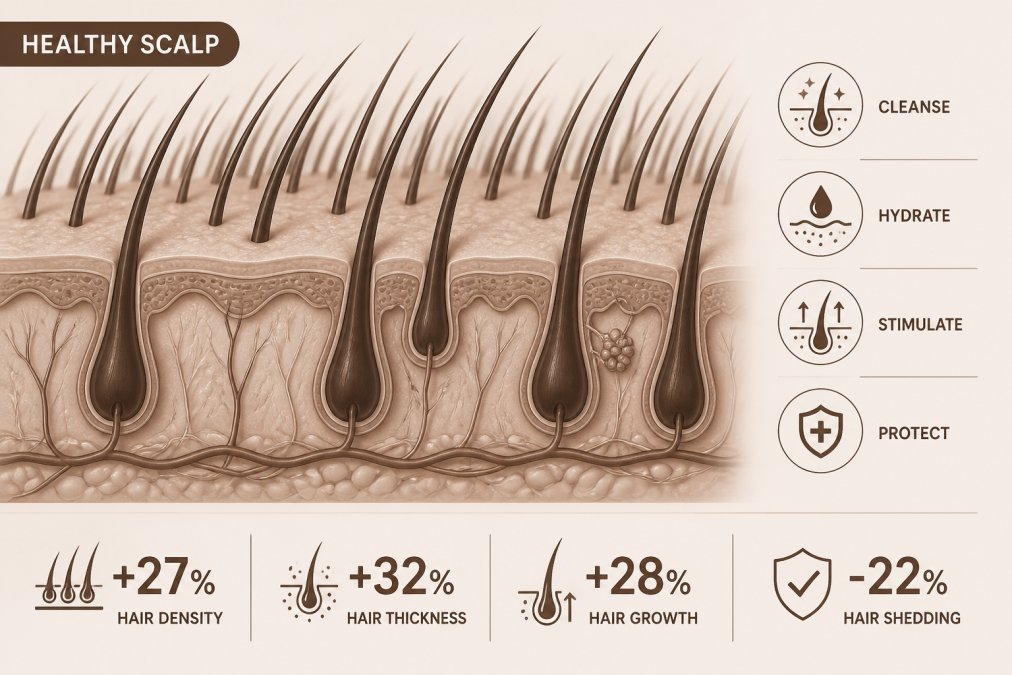
The key difference between a standard shampoo and a growth-focused formula lies in ingredient selection. Standard shampoos clean; growth shampoos clean whilst also delivering botanicals that support the follicle and scalp microbiome. Consistent use over weeks allows cumulative benefits. Hair growth happens slowly, the anagen phase lasts 2-7 years depending on genetics, so meaningful changes in hair density take time to manifest.
Best Ingredients for Hair Growth in Organic Formulas
Plant-Based Actives That Support Follicle Health
The most effective organic hair growth shampoos share core plant-based actives, each chosen for specific roles in supporting follicle function and hair strength.
Caffeine is one of the most researched botanical ingredients for scalp health. It increases blood flow to the scalp, enhancing nutrient delivery to follicles, and has mild anti-inflammatory properties that may calm scalp irritation. Many practitioners report that caffeine-based formulas feel energising on the scalp and are particularly helpful for early-stage thinning.
Rosemary oil has long traditional use in hair care, now validated by modern research. The plant contains compounds that may support follicle health and encourage the hair growth cycle. Rosemary is often combined with other botanicals because its effects are cumulative with consistent use.
Saw palmetto is a botanical extract that some practitioners recommend for its potential role in supporting scalp health.
Biotin and plant-derived proteins strengthen the hair shaft itself. Biotin is essential for keratin production, and organic shampoos often include biotin from plant sources. Proteins derived from seeds, grains, or plant matter coat the hair cuticle and reduce breakage.
Natural surfactants matter significantly. Harsh synthetic detergents strip the scalp and hair, leaving them dry and prone to breakage. Organic formulas use gentler, plant-derived surfactants that cleanse without stripping, preserving the scalp barrier and natural oils that protect hair.
Why Scalp Microbiome Balance Matters
The scalp microbiome, the community of microorganisms living on your scalp, directly influences hair health. A balanced microbiome supports a healthy scalp barrier and reduces inflammation. An imbalanced one can trigger scalp sensitivity, excess sebum production, or dryness, all of which impair hair growth.
Organic shampoos that support scalp microbiome health avoid harsh ingredients that disrupt the microbial community. Some formulas include prebiotics or botanical extracts that feed beneficial microbes. The result is a more resilient scalp environment where follicles function optimally. This is where the science behind organic formulas becomes relevant: synthetic detergents and chemical preservatives can disrupt the scalp microbiome, whilst plant-based alternatives are gentler on this delicate ecosystem.
How Long Does Hair Growth Shampoo Take to Work
The timeline for seeing results from an organic hair growth shampoo depends on what you're measuring and your starting point.
Immediate effects (first wash to two weeks): Your hair will feel cleaner and often softer. The scalp may feel calmer if you've been using harsh products. These are real benefits reflecting improved hair condition and scalp comfort, though not growth itself.
Short-term changes (4-8 weeks): If breakage was significant, you may notice less hair shedding in the shower or brush. New hair will be stronger and less prone to splitting. Hair texture may improve and shine may increase, reflecting better hair shaft strength and scalp health.
Meaningful growth changes (12-16 weeks): This is when you might notice a difference in hair density or fullness. Hair grows roughly 1.25 cm per month, so 12 weeks gives you about 3.75 cm of new growth. If that new growth is stronger and less prone to breakage, it becomes visible.
Long-term results (6 months and beyond): The most noticeable improvements happen between months 4 and 8. By six months of consistent use, you should have a clear sense of whether the shampoo is supporting your hair growth.
The critical variable is consistency. A shampoo used three times per week will show slower results than one used daily. Hair growth is governed by your hair cycle, so patience is essential.
Understanding the Shedding Phase and Purging
One of the most misunderstood aspects of starting a new hair growth shampoo is the initial shedding phase, sometimes called "purging." Many people interpret increased shedding as a sign the product isn't working or is making things worse. In reality, it's often a sign the product is working.

What happens during purging: When you introduce a shampoo with active ingredients that stimulate follicle function, the follicles respond by accelerating their cycle. Hairs in the late catagen or telogen phase (resting or shedding phases) move toward shedding faster, creating a temporary increase in hair loss for 2-4 weeks. This is not hair being damaged, it's hair being cycled out faster because the follicles are more active. Older, weaker hairs fall out, making room for new, stronger growth.
How long does purging last: Most people experience noticeable purging for 2-4 weeks. Some experience it for up to 6 weeks. After this phase, shedding returns to baseline or drops below baseline as new, stronger hairs grow in.
How to know if it's purging or a problem: If shedding increases moderately for 2-4 weeks and then decreases, that's purging. If shedding increases dramatically and continues beyond 6 weeks, or if you experience scalp pain or irritation, the shampoo may not suit your scalp. Purging is uncomfortable but temporary; true incompatibility is persistent.
Expect some increased shedding in the first month. This is normal and often a sign the shampoo is engaging with your hair cycle.
Organic Versus Synthetic: What the Evidence Shows
The comparison between organic and synthetic hair growth formulas often comes down to philosophy and skin sensitivity rather than raw efficacy.
Synthetic actives like minoxidil are well-studied with clinical evidence supporting their role in hair regrowth. They work through specific biochemical pathways and deliver consistent, measurable results for many people. The downside is that they can cause scalp irritation, and they require ongoing use indefinitely, stopping reverses the gains.
Organic formulas rely on plant-based actives that have been used traditionally and are increasingly supported by modern research. They tend to be gentler on the scalp and work through supporting overall scalp health rather than forcing a single biochemical pathway. Results may be slower and more subtle, and the evidence base is smaller than for synthetic options.
For people with sensitive scalps, reactive skin, or a preference for plant-based products, organic formulas often deliver better results simply because they're tolerable long-term. Consistency matters more than potency when it comes to hair growth, and a gentle formula you'll use daily for six months beats a potent one you abandon after two weeks due to irritation.
What Shampoo Cannot Do Alone
A hair growth shampoo, however well-formulated, has limits.
It cannot override genetics. If pattern hair loss runs in your family, a topical shampoo alone cannot stop it. Genetics determine your hair loss sensitivity and hair cycle timeline. A shampoo can support the hair you do grow, but it cannot change your genetic predisposition.
It cannot replace medical treatment. If your hair loss is driven by a hormonal condition, thyroid dysfunction, nutritional deficiency, or other medical factors, the shampoo is a supporting tool, not a treatment. Address the underlying cause first.
It cannot work without consistency. Hair growth shampoos require daily or near-daily use to deliver results. Sporadic use won't produce meaningful change.
It cannot deliver results in isolation. The most successful hair growth routines combine a quality shampoo with scalp massage to boost circulation, adequate protein and micronutrient intake, stress management, and sometimes complementary treatments.
It cannot work overnight. Realistic timelines are 8-12 weeks before you notice meaningful change, and 6 months before you see significant results.
What a quality organic hair growth shampoo can do is create optimal conditions for the hair you're growing. It can reduce breakage, calm inflammation, support the scalp microbiome, and deliver nutrients to follicles. Combined with other supportive practices, it becomes a meaningful part of a hair health routine.
Conclusion
Organic hair growth shampoo works by supporting scalp health, reducing breakage, and creating an environment where follicles function optimally. It works slowly, requiring months of consistent use before meaningful results appear. It works best as part of a broader hair health routine, not as a standalone solution.
The most important decision is choosing a formula with genuine active ingredients and a clean, scalp-friendly base. Harmony Harvest's Hair Care collection is formulated with COSMOS-certified organic botanicals designed to support scalp health and hair strength without synthetic detergents or harsh chemicals. Our plant-based approach prioritises scalp barrier function and microbiome balance, creating conditions for sustainable hair growth.
If your hair thinning is driven by poor scalp health, breakage, or suboptimal care, an organic hair growth shampoo can make a measurable difference. If it's driven by genetics or medical factors, the shampoo becomes a valuable supporting tool alongside other treatments. Either way, consistency, realistic timelines, and patience are non-negotiable.
Explore our Hair Care collection to find a formula suited to your scalp and hair type. Every product is COSMOS-certified organic, vegan, and cruelty-free, formulated with pure Australian botanicals to support your hair health naturally.
Frequently Asked Questions
What ingredients should I look for in an organic hair growth shampoo?
Look for plant-based actives like rosemary oil, biotin, caffeine infusion, and saw palmetto, these support follicle stimulation and scalp circulation naturally. Organic shampoos should also contain natural surfactants that cleanse without stripping the scalp's protective barrier. Ingredients that regulate sebum and reduce scalp inflammation help create an environment where hair can grow stronger. COSMOS-certified organic formulas ensure these botanicals are grown without synthetic pesticides, which is particularly important if you have sensitive skin.
How long does hair growth shampoo take to work?
Most people notice visible improvements in hair texture and reduced breakage within 4-6 weeks of consistent use. However, meaningful changes in hair density and thickness typically take 8-12 weeks or longer, because hair growth follows the anagen phase of the hair cycle, which spans months. Be patient during the first 2-3 weeks; some people experience a temporary shedding phase as the scalp adjusts. Results depend on consistent use, overall scalp health, and whether you're addressing underlying causes of thinning.
Can organic hair growth shampoo alone stop hair loss?
Shampoo alone cannot stop significant hair loss caused by genetics, hormonal changes, or medical conditions. However, organic hair growth shampoos can support scalp health, reduce breakage, and improve hair shaft strength, which helps minimise the appearance of thinning. For clinical hair loss, shampoo works best as part of a broader approach that may include scalp treatments, supplements, and professional advice. If you're experiencing rapid or severe hair loss, consult a healthcare provider to rule out underlying causes.
What's the difference between organic and synthetic hair growth shampoos?
Organic shampoos use plant-derived ingredients like rosemary oil and biotin to support scalp circulation and keratin production, while synthetic formulas often rely on chemical DHT blockers or laboratory-created actives. Organic formulas tend to be gentler on sensitive scalps and support the scalp microbiome naturally, whereas synthetic options may deliver faster, more clinically proven results in some cases. The trade-off: organic shampoos work more slowly but typically cause fewer side effects and align with values around sustainability and natural beauty rituals.
This article was written using GrandRanker
Best Sellers

Read more
Plant-Based Shampoo to Prevent Seasonal Hair Shedding
Plant-based shampoo to prevent seasonal hair shedding: Plant-based shampoo can help prevent seasonal hair shedding. Learn which botanical ingredients.
Read more
Hair Loss: Causes, Treatments & Natural Care
Understand hair loss causes, types, and treatments. Learn natural scalp care tips and when to seek medical help. Discover holistic solutions.
Read more