

Natural vs Organic Skincare Standards: 2026 Guide
Table of Contents
- Natural vs Organic Skincare Standards: The Core Difference
- COSMOS Organic Certification: What the Standard Actually Requires
- COSMOS Organic vs COSMOS Natural: Two Tiers, One Framework
- How to Read Organic Skincare Labels Without Getting Fooled
- How to Verify a Certification Claim (and Spot Greenwashing)
- Does Organic Automatically Mean Safer for Sensitive Skin?
- Choosing Products That Meet Organic Skincare Standards
- Frequently Asked Questions
Last Updated: October 7, 2026
Natural vs Organic Skincare Standards: The Core Difference
The words on a skincare label are not regulated the way most shoppers assume. Understanding natural versus organic skincare standards starts with one fact: "natural" describes where an ingredient came from, while "organic" describes how it was grown and processed. At Harmony Harvest, we work with COSMOS-certified organic formulas every day, and this distinction is the single most useful thing a shopper can learn.
Natural ingredients are derived from plants, minerals or other living sources. Organic ingredients meet additional farming and processing rules, usually verified by an independent certifier.
Below, we break down what each term actually means, how certification works, and how to check a claim before you spend money on it.
What 'Natural' Means for Cosmetic Ingredients
Natural refers to ingredient origin: a substance that comes from a plant, mineral or animal source rather than being synthesised in a lab.
That definition is broad. It can include plant oils, clays, beeswax and botanical extracts. It can also include ingredients that started natural but were chemically altered during processing. Many brands use "natural" loosely because no single regulator enforces a fixed definition for cosmetics. According to Refresh Botanicals' explainer on natural vs organic skincare, natural products may still contain synthetic ingredients, which is exactly why the term alone tells you very little.
What 'Organic' Means and How Ingredients Are Grown
Organic describes how an ingredient was grown and handled: without certain synthetic pesticides and fertilisers, under documented conditions, with a traceable supply chain.
This is where organic skincare standards do real work. A botanical can be natural and still be grown with synthetic inputs. Organic certification closes that gap by requiring proof. The Ogee guide to natural, organic and clean beauty draws the same line: natural relates to ingredient origin, organic relates to growing and processing practices.
COSMOS Organic Certification: What the Standard Actually Requires
COSMOS is a certification framework for cosmetics described as organic or natural, and it is the standard behind our own range. Understanding what it actually requires means looking at the mechanics, not the logo.
COSMOS works on a points-based system. Every ingredient in a formula is classified into one of five categories, from water (the least restricted) through to agricultural ingredients, then to ingredients of mineral or animal origin, and finally to a small permitted set of synthetic ingredients. Each category carries a different weighting, and a product must reach a minimum score to qualify. That is why two products can both carry a COSMOS logo yet contain very different ingredient profiles.
To carry a COSMOS ORGANIC claim, a product must meet defined thresholds for organic content, use only permitted ingredients, and follow approved manufacturing and packaging rules. Certification is granted by an independent body after audit, not self-declared by the brand. The COSMOS Standard official site sets out the full framework, including the ingredient classification system and the processing rules that apply at each tier.
A few practical points that matter when you are comparing logos:
- The certifier is separate from the standard. COSMOS is the framework; the audit is carried out by an approved certification body. Two products can both be COSMOS-certified but audited by different bodies.
- Certification applies to a specific product, not a whole brand. A brand may hold COSMOS certification for one range and not another. Always check the product, not the company.
- The certificate has a scope and an expiry. Certification is renewed periodically, so a logo on an old product page may no longer reflect current status.
The NATRUE certification scheme is a comparable example of how certifiers categorise ingredients as natural, derived natural or nature-identical, and it is worth knowing that different schemes draw these lines in different places. That is the subject of the next section.
COSMOS Organic vs COSMOS Natural: Two Tiers, One Framework
COSMOS ORGANIC and COSMOS NATURAL sit under the same certification umbrella but carry different requirements.
COSMOS ORGANIC demands a minimum share of organic ingredients and stricter sourcing rules. COSMOS NATURAL allows a broader ingredient set while still excluding certain synthetic materials. Neither tier permits a brand to simply call itself organic without verification.
| Tier | Organic content requirement | Ingredient rules | Best for |
|---|---|---|---|
| COSMOS ORGANIC | Minimum organic share required | Strict sourcing and processing | Shoppers prioritising certified organic content |
| COSMOS NATURAL | No organic minimum | Broader permitted ingredients | Shoppers wanting certified natural origin |
How to Read Organic Skincare Labels Without Getting Fooled
Start with the ingredient list, not the front of the bottle. Marketing copy is unregulated; the INCI list and any certification logo are the parts a brand has to stand behind.
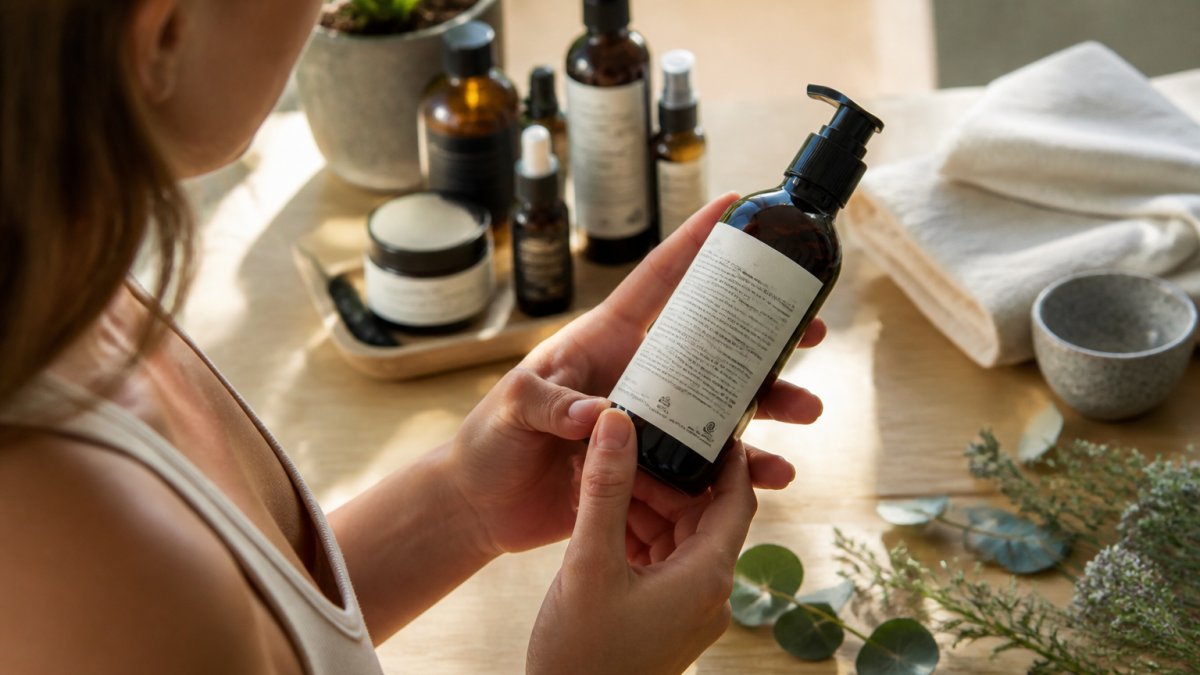
Work through it in this order:
- Find the certification logo and the certifier's name
- Check whether it says COSMOS ORGANIC or COSMOS NATURAL
- Read the ingredient list for where botanicals sit in the order
- Look for a stated organic percentage, if any
- Verify the certifier independently before buying
Percentage Claims, Water, and the Minimum Threshold
An "organic percentage" claim is easy to misread because water is often the largest single ingredient in a formula.
Water cannot be certified organic, so different standards treat it differently when calculating percentages. A product can legitimately advertise a high organic figure while water still dominates the bottle. The Cosmébio report on comparing organic and conventional cosmetics notes that price and percentage comparisons require real analysis rather than a glance at the label.
How to Verify a Certification Claim (and Spot Greenwashing)
Verification takes about two minutes and almost nobody does it. That is precisely why greenwashing works.
Check the certifier's own website, search the brand name, and confirm the product range listed. Legitimate certifiers publish certified brands. If a brand claims certification but appears nowhere on the certifier's register, that is your answer.
Does Organic Automatically Mean Safer for Sensitive Skin?
No. Organic certification says nothing about whether a specific ingredient will suit your skin.
Natural and organic ingredients can still trigger irritation in reactive skin. The Juice Beauty evidence-based guide to organic skincare makes this point directly: natural or organic origin does not guarantee a product will suit every person. Patch test anything new, certified or not. What organic certification does give you is traceability and a documented supply chain, which matters if you react and need to identify the cause.
Choosing Products That Meet Organic Skincare Standards
Buy from brands that name their certifier, publish their ingredient list in full, and can explain the difference between their organic and natural lines.
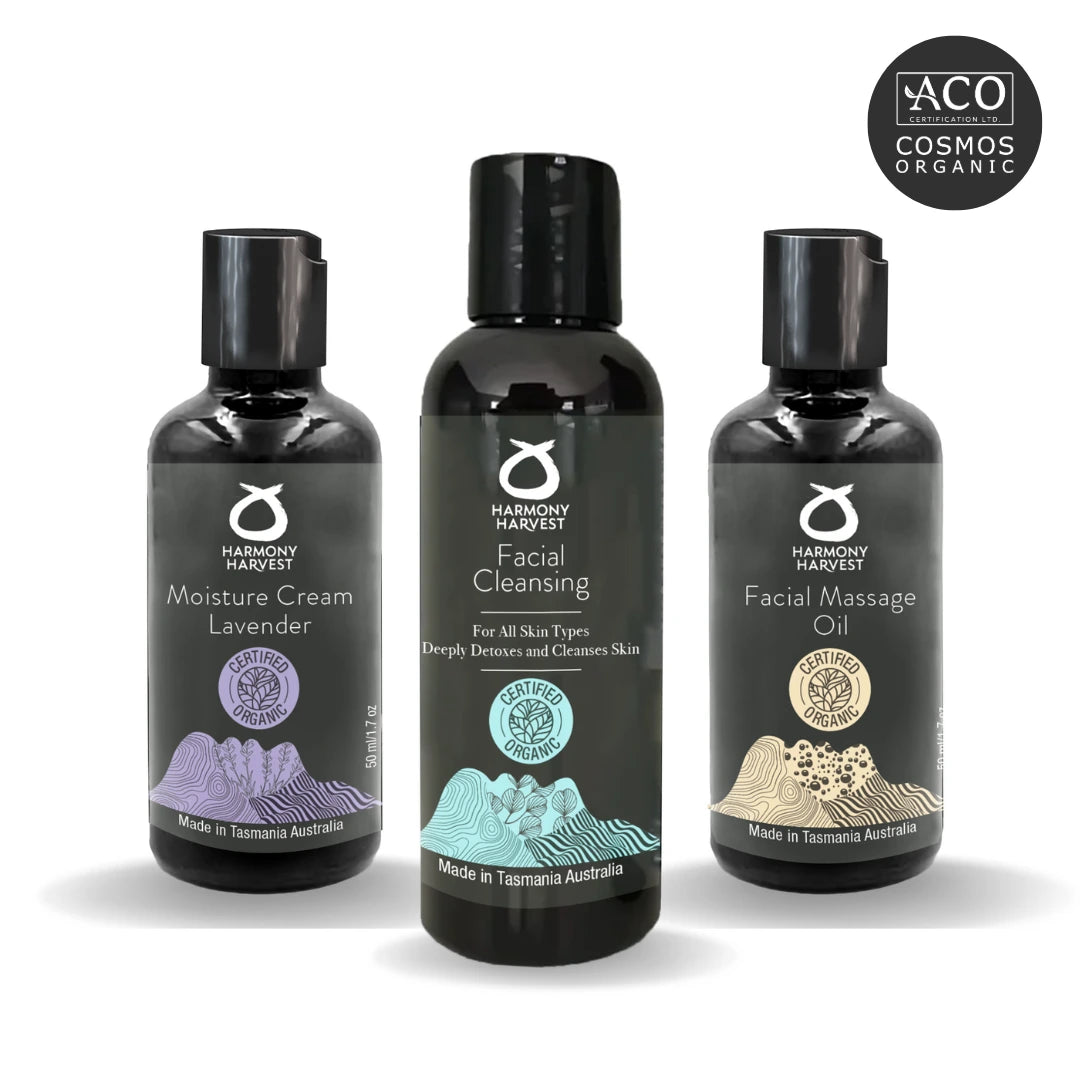
At Harmony Harvest, our products are COSMOS-certified organic and vegan, formulated with Australian botanicals and free from synthetic detergents. That certification is the standard we build every formula around, and it is the reason we can tell you exactly what is in the bottle. If you are ready to put these standards to work, our Facial Care and Body Care ranges are a gentle place to start, and every product in them is COSMOS-certified organic, vegan and cruelty-free.
Frequently Asked Questions
What is the difference between natural and organic skincare?
Natural refers to where an ingredient comes from: it is derived from plants, minerals or other natural sources. Organic goes further and describes how that ingredient was grown and processed, under certified farming rules that restrict synthetic pesticides and fertilisers. A product can be natural without being organic, but a certified organic product must also meet organic skincare standards for its agricultural ingredients. This is why the two terms are not interchangeable on a label.
How can you tell if skincare is certified organic?
Look for a recognised certification logo on the packaging, such as COSMOS Organic, and check the certifying body's public database to confirm the brand and product are listed. A genuine claim will name the standard and the certifier, not just use the word 'organic' in marketing copy. If a product says 'organic' but shows no logo, no certifier and no verifiable listing, treat the claim as unproven until the brand provides evidence.
What does COSMOS Organic certification mean?
COSMOS Organic is a certification standard for cosmetics that sets requirements for how ingredients are sourced, processed and labelled. It sits within the COSMOS framework alongside COSMOS Natural, with the Organic tier requiring a defined minimum share of organic ingredients in the formula. Certified products carry the logo and are subject to third-party verification, which is what separates them from a brand simply describing itself as organic.
Is natural skincare regulated in Australia?
Cosmetics sold in Australia are regulated for safety, and the use of the word 'organic' on a cosmetic is not the same as a regulated certification. That means a brand can describe a product as natural or organic without holding a certification, provided it does not make claims that are false or misleading. Certification schemes like COSMOS provide the independent verification that general label wording does not.
Does organic mean 100% natural?
No. Organic certification allows some ingredients that are not simply raw plants, including certain preservatives and processing aids, because a stable product needs them. What the standard controls is which ingredients are permitted, how agricultural ingredients are grown, and what share of the formula must be organic. So an organic product is not automatically 100% natural, and a 100% natural product is not automatically organic.
Are natural and organic skincare products better for you?
Natural or organic origin does not guarantee a product will suit every person. Plant-derived ingredients can still cause irritation in sensitive skin, and how a formula is put together matters as much as where its ingredients come from. A certified organic product gives you verified sourcing and permitted-ingredient rules, but the right choice still depends on your skin and how it responds.
How much of a skincare product needs to be organic to be certified?
The answer depends on the standard. COSMOS Organic requires a defined minimum percentage of organic ingredients in the formula, and the calculation is affected by water content, since water is not an agricultural ingredient and cannot count as organic. That is why two products can both be certified yet carry different organic percentages, and why reading the small print matters more than the front-of-pack claim.
What are the top ingredients to avoid in skincare products?
Rather than memorising a list, focus on what you personally react to and what the label discloses. Fragrance and some preservatives are common triggers for sensitive skin, so patch testing a new product before full use is sensible. Certified standards such as COSMOS restrict which ingredients are permitted, which gives you a verified starting point rather than relying on marketing terms alone.
Choosing skincare that genuinely meets organic standards comes down to one habit: check the certifier, not the marketing. Harmony Harvest makes that easy, with a COSMOS-certified organic, vegan and cruelty-free range built on Australian botanicals and free from synthetic detergents. Explore our Facial Care collection to start with formulas designed to hydrate, support your skin barrier and promote a radiant glow.
Best Sellers
Read more
Is Plant-Based Skincare Effective for Wrinkles?
Is plant-based skincare effective for wrinkles? Explore the evidence on collagen, plant peptides and realistic results for mature skin.
Read more
How to Repair a Damaged Skin Barrier Naturally: 2026 Guide
Learn how to repair a damaged skin barrier naturally, with a step-by-step skin barrier repair routine and a realistic recovery timeline.
Read more