


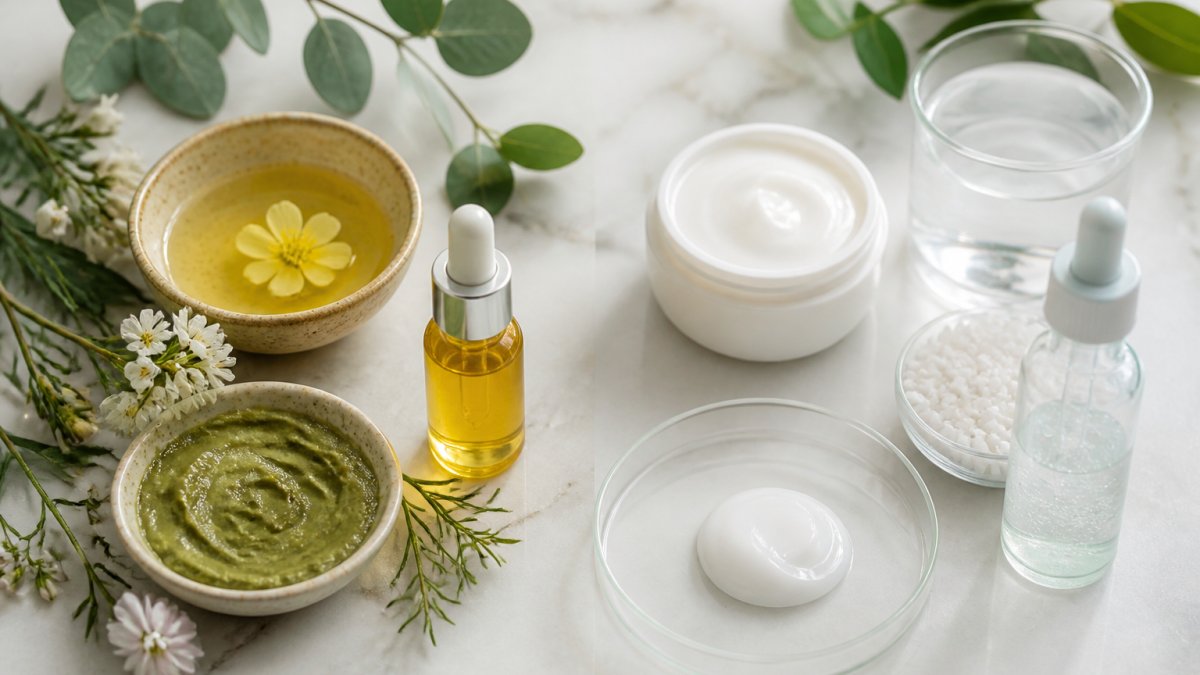
Organic vs Synthetic Skincare Ingredients: Key Differences
Table of Contents
- Organic vs Synthetic Skincare Ingredients: The Core Differences
- The Myth That Natural Always Means Safer
- How to Read Skincare Ingredient Labels Like a Formulator
- Bio-Identical and Lab-Made Ingredients: The Category Labels Miss
- Benefits of COSMOS-Certified Organic Skincare for Your Barrier
- Shelf Life, Preservation and Formulation Stability Compared
- Transitioning to a Clean Beauty Routine Without the Guesswork
- Cost, Environmental Footprint and What You Actually Pay For
- Frequently Asked Questions
Last Updated: September 27, 2026
Organic vs Synthetic Skincare Ingredients: The Core Differences
The organic vs synthetic skincare ingredients difference comes down to origin, molecular structure and how each behaves on skin. Organic ingredients are plant-derived and certified through recognised standards, while synthetic ingredients are created in a laboratory, often to mimic what nature already does. This guide from Harmony Harvest breaks down what actually separates the two, so you can choose with confidence rather than marketing noise.
Cosmetic Ingredient Dictionary and labelling guidance
What Counts as a Natural or Organic Ingredient
A natural ingredient starts as a plant, mineral or microbe and is processed without fundamentally changing its chemical composition. Organic goes a step further: it is grown and handled under a certified farming standard.
- Plant-derived oils, butters and waxes
- Botanical extracts and floral waters
- Clays, salts and mineral pigments
- Cold-pressed or minimally refined ingredients
What Counts as a Synthetic Ingredient
A synthetic ingredient is built in a lab, either from petrochemicals or by reproducing a molecule found in nature. Not every synthetic is harsh, and not every natural is gentle. That distinction trips up a lot of shoppers.
- Preservative systems that prevent microbial growth
- Emulsifiers that stop oil and water separating
- Silicones that create a smooth feel
- Lab-made versions of vitamins and peptides
The Myth That Natural Always Means Safer
Natural does not automatically mean safer, and synthetic does not automatically mean harmful. This is the biggest misconception in the clean beauty conversation.
Australian Competition and Consumer Commission guidance on green claims
How to Read Skincare Ingredient Labels Like a Formulator
Reading a label like a formulator means scanning the INCI list, checking ingredient order, and knowing which certifications actually mean something. The INCI (International Nomenclature of Cosmetic Ingredients) list is the standardised naming system used on skincare labels worldwide.
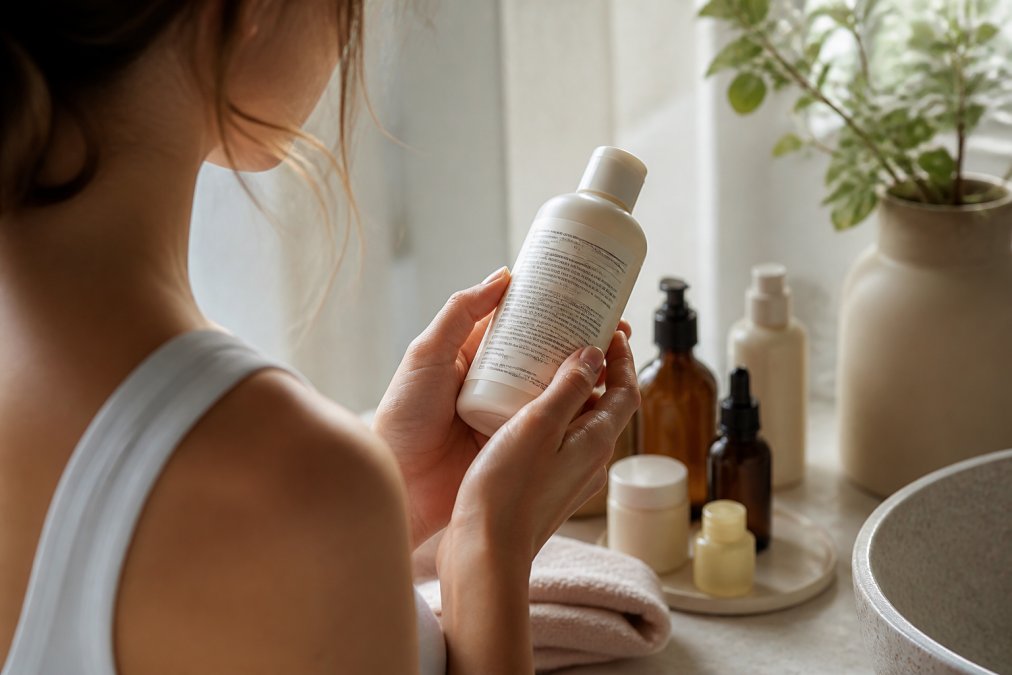
The INCI List and What Order Really Tells You
Ingredients are listed in descending order of concentration, down to about one per cent. Anything after that can appear in any order. So the first five ingredients tell you what the product mostly is.
A few practical reads:
- Water (Aqua) first usually means a lightweight lotion or serum, not a rich balm.
- Glycerin high on the list signals a humectant-led formula that draws water into the upper skin layers.
- Alcohol Denat. near the top can mean a fast-drying, potentially drying formula for reactive skin.
- Fragrance (Parfum) is a catch-all term that can hide dozens of individual allergens, which matters if your skin is reactive.
- Botanical extracts listed after the preservative are often present at concentrations too low to do much beyond label appeal.
Decoding 'Natural', 'Clean' and Certification Logos
The words "natural" and "clean" are largely unregulated marketing terms in Australia. The ACCC has taken action against brands making misleading "organic" or "natural" claims where the evidence did not support them, and its guidance on green claims makes clear that businesses must be able to substantiate environmental and origin claims.
| Label term | What it actually guarantees | How to verify |
|---|---|---|
| "Natural" | Minimal processing of some ingredients | No formal standard; ACCC green-claims rules apply to the claim itself |
| "Clean beauty" | Brand's own exclusion list | Check the brand's criteria; no external audit |
| "Organic" (uncertified) | Often nothing verifiable | Look for a certification logo instead |
| COSMOS-certified organic | Audited organic content and sourcing | Certification logo and register |
| Vegan | No animal-derived ingredients | Certification or brand statement |
Australian Competition and Consumer Commission guidance on green claims
A Three-Step Label Check You Can Do in the Aisle
- Flip to the INCI list. Ignore the front-of-pack claims entirely; they are marketing, not regulation.
- Scan the first five ingredients. These define what the product mostly is. If the actives you care about are not there, they are likely present at token levels.
- Look for a certification logo. If the brand claims organic or natural, a recognised certification is the only way to verify it without taking the brand's word for it.
Bio-Identical and Lab-Made Ingredients: The Category Labels Miss
Bio-identical ingredients are lab-made molecules that match a naturally occurring one exactly. They sit in a category that "natural versus synthetic" labels simply cannot describe.
Benefits of COSMOS-Certified Organic Skincare for Your Barrier
COSMOS-certified organic skincare supports the skin barrier by delivering plant-derived lipids, antioxidants and humectants without a heavy load of potential irritants. Your barrier is the outermost layer of skin, and its job is to hold moisture in and keep irritants out.
- Replenishes barrier lipids with plant-derived oils
- Delivers antioxidants that help defend against environmental stress
- Avoids synthetic detergents that can strip natural oils
- Supports a calmer, more resilient complexion over time
Shelf Life, Preservation and Formulation Stability Compared
Synthetic preservative systems generally give products a longer shelf life, while organic formulas rely on gentler preservation and tend to have shorter windows. That trade-off is real, and it is worth understanding.
Transitioning to a Clean Beauty Routine Without the Guesswork
Transitioning to a clean beauty routine works best when you swap products one at a time, not all at once. A sudden overhaul makes it impossible to tell what is helping and what is not.
- Swap one product at a time, every two to three weeks
- Start with leave-on products, then cleansers
- Keep the core routine to three or four steps
- Note how your skin feels each week, not each day
Cost, Environmental Footprint and What You Actually Pay For
The price gap between organic and conventional skincare reflects more than the ingredients. It covers certification, smaller production runs, sustainable packaging and the cost of growing botanicals to an audited standard.
The Lifecycle Angle Most Comparisons Skip
It is tempting to assume natural always wins on environmental footprint. A lifecycle view is more honest.
- Land and water use. Resource-heavy botanicals such as certain floral waters and cold-pressed oils can demand significant land, water and seasonal labour per kilogram of usable ingredient.
- Yield and waste. A lab-made version of the same molecule can be produced at high purity with far less agricultural input, which sometimes lowers the total footprint per gram.
- Transport and seasonality. Botanicals grown in one region and shipped globally carry freight emissions that a locally synthesised equivalent may avoid.
- Packaging and end-of-life. Glass, refillable formats and recycled materials lower impact, while airless pumps reduce waste from oxidised product but are harder to recycle.
What You Are Actually Paying For
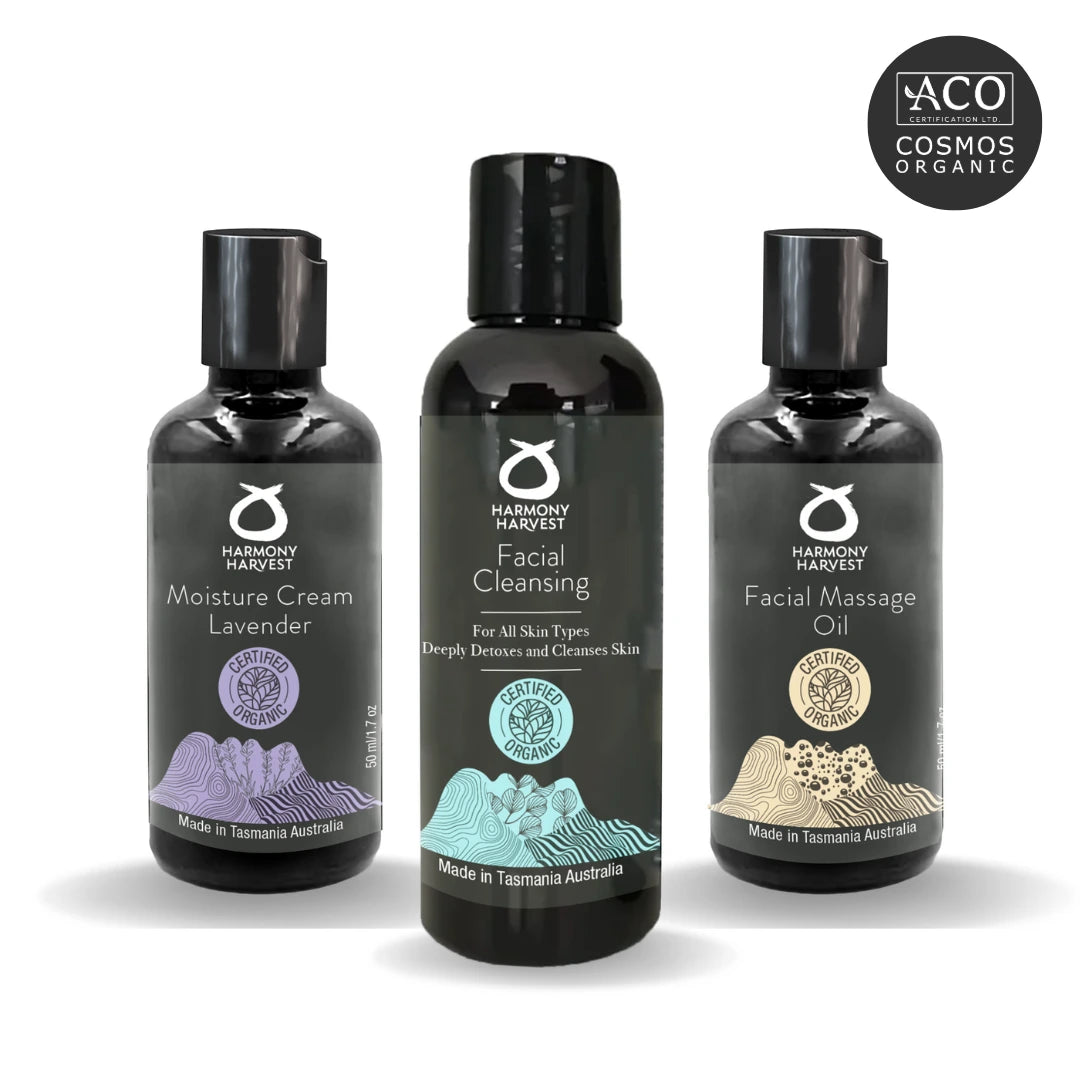
If you are ready to put all of this into practice, our COSMOS-certified organic and vegan Facial Care range is a gentle place to start, with cleansers, serums and moisturisers formulated to support your skin barrier. For the rest of your routine, [our Body Care collection](/collections/body-care) carries the same COSMOS-certified organic, vegan and cruelty-free standards from neck to toe.
Frequently Asked Questions
What is the fundamental difference between organic and synthetic skincare ingredients?
Organic ingredients are plant-derived and grown under certified farming standards, while synthetic ingredients are made in a lab, often to mirror molecules found in nature. The organic vs synthetic skincare difference comes down to origin, how each is standardised, and how the finished formula behaves on your skin. Neither category is automatically better; what matters is purity, concentration and how the formula suits your skin barrier.
Are synthetic ingredients always harmful to the skin?
No. Many synthetic ingredients are well tolerated and play useful roles, such as preservative systems that keep a product free of mould and bacteria. The concern is not 'synthetic' as a label but the specific molecule, its concentration and your skin's response. Some people react to fragrance allergens or certain preservatives; others react to botanical extracts or essential oils. Patch testing is the practical way to find out what your skin accepts.
Does the term 'natural' mean the same as 'organic' in skincare?
They are not interchangeable. 'Natural' has no single legal definition in skincare and can appear on almost any plant-based product. 'Organic' refers to how ingredients are farmed and processed, and it is only meaningful when backed by a certification such as COSMOS. A product can be natural without being certified organic, so always look for the certification logo rather than the word on the front of the pack.
How can I tell if a product is genuinely organic and not just greenwashing?
Check the certification, not the marketing. A COSMOS-certified product must meet strict rules on ingredient sourcing, processing and packaging, and the certifier's logo will appear on the label. You can also read the INCI list: certified organic ingredients are usually marked with an asterisk, and water or aloe vera often appears first. If a brand claims organic status but shows no certifier, treat the claim with caution.
Does switching to organic skincare mean a longer or more complicated routine?
Not necessarily. Transitioning to a clean beauty routine can be as simple as swapping one product at a time, starting with your cleanser or moisturiser. A basic three-step routine (cleanse, treat, moisturise) works well with COSMOS-certified organic formulas. Give your skin two to four weeks to adjust, introduce one new product at a time, and keep the steps you actually use rather than adding products you do not need.
Choosing between organic and synthetic skincare ingredients comes down to what your skin needs and what you value. If you want formulas that support your barrier with traceable, plant-derived ingredients, Harmony Harvest makes the decision simple. Our Facial Care collection is COSMOS-certified organic, vegan and cruelty-free, formulated with Australian botanicals to hydrate, nourish and support a radiant complexion. Explore the Facial Care range and build a routine your skin will thank you for.
Best Sellers
Read more
7 Best Organic Vegan Skincare Brands for Sensitive Skin
Discover the 7 best organic vegan skincare brands for sensitive skin in 2026, plus how to choose and the benefits of COSMOS-certified organic formulas.
Read more
How to Fix Damaged Hair Ends: A 2026 Repair Guide
Learn how to fix damaged hair ends with a diagnostic-led repair plan, from bond builders to deep conditioning. Discover stronger, softer hair today.
Read more